Brussels, 23 June 2026
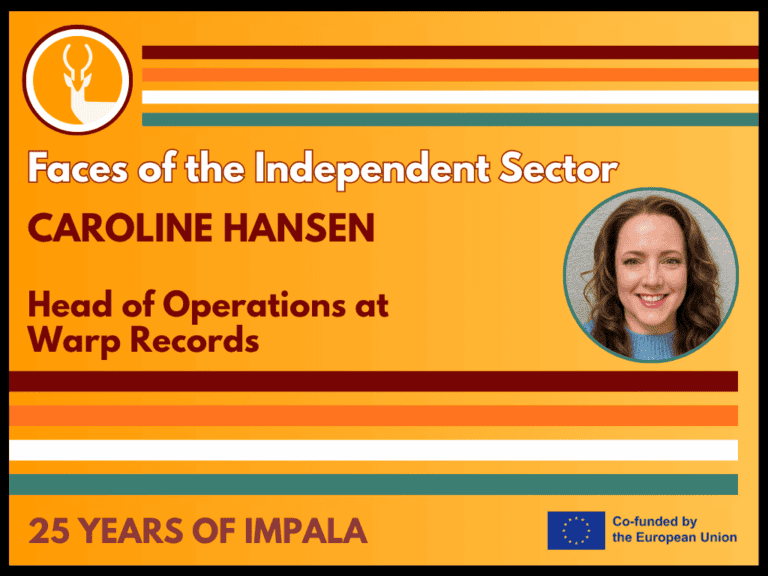
As part of IMPALA’s Faces of the Independent Sector storytelling series, co-funded by the European Union, and celebrating our 25th anniversary, we are sharing the seventh interview in the series with Caroline Hansen, Head of Operations at Warp Records, IMPALA sustainability task force member and co-chair of the Music Climate Pact digital working group.
In the interview, Caroline describes her previous roles in the music industry before finding her niche in record label operations. She explains how working in the independent sector allows for a unique sense of autonomy. With EU Green Week putting the spotlight this year on the business case for sustainability, Caroline’s interview is a timely illustration of how independents can lead the way as they are able to move easily.
Caroline also talks about the importance of collaboration around what can be achieved by coming together for the common good on sector-wide issues, such as AI, visibility and sustainability.
Check out what Caroline has to say at Music Climate Pact’s panel, The Journey of a Song, at Earthfest tomorrow, as well as the digital working group’s guidelines for labels.
What do you do in the music sector?
“I am a music operations nerd and currently Head of Operations at Warp Records where I oversee release management, production, physical manufacturing, digital distribution, and technology. My career has been split roughly 50:50 between roles at independent and major record labels. This has provided a diversity in experience and perspective that I value, in addition to helping me appreciate the independent sector and what makes it special.”
How did you start working in the music sector?
“My first full-time role in music was as an administrative and development assistant at Bargemusic, a small non-profit classical chamber music society in New York. My undergraduate university degree was in music theory and performance, so working in classical music was a logical first career step that I really appreciated and is how I discovered that I enjoyed the business side of music. My first job in a record label came next as an unpaid work experience position and then a paid temporary administration assistant role in the A&R department at Virgin Records, followed up by a part-time role in Arista’s Marketing team at Star Trak while waitressing on the side. Getting past those first few hurdles of entry into the record label world took some hard work and grinding, especially at a time when major labels were cutting a third of their staff as a result of the digital turmoil of the early 2000s, but I fell in love with the record business and knew it was where I wanted to be. However, at that stage, I discovered my niche in operations, which took a couple more years. What I did discover, though, was how ill-suited I was to Marketing and A&R! Sometimes figuring out what you don’t like is just as important as figuring out what you do like.”
What does being independent mean to you?
“There is a unique sense of freedom, autonomy, and agency working within an independent label that enables the ability to get stuff done quickly, to implement new ideas, take ownership, and see your contributions make a tangible difference to your artists and colleagues. There’s also a spirit of collaboration across independents around what can be achieved by coming together for the common good. And within the independents that I’ve worked at, a very clear sense of an artist-focused purpose in what we do.”
What are the biggest opportunities for the independent sector today?
“I’d like to look at this question from an ops and tech perspective. Change brings opportunities, and we’re certainly going through an important global technology transition right now with LLMs and AI. If deployed smartly, this technology will allow us to do more than we can today and help alleviate the team resourcing and tech capability pressures that we continually face in the independent sector.
We’ll be able to more easily build the tech solutions needed to keep pace with the ever-evolving complexity of revenue channels, speed up and remove the manual admin work that bogs down our teams so they can focus on the higher-value work they sometimes struggle to find time for today. Additionally, AI brings a new way for our fans to engage with our artists and their music with tools that, for example, allow them to easily manipulate and reinvent their favourite song.
This desire to engage with the music we love is perpetual and powerful – from mix tapes to burned CDs to file sharing to digital playlisting and now, AI. We also have a unique opportunity as an independent sector to lead the way in reducing the global carbon footprint of physical and digital music across the industry (including digital distributors and streaming services). This is due to our ability to more easily change how we make and distribute music, such as eliminating air shipping, moving to more sustainable materials for all physical formats, and rationalising our digital distribution in meaningful ways.”
What are the biggest challenges for the independent sector today?
“We can’t speak about the technical opportunities of AI without also highlighting the deep challenge this represents to intellectual property, copyright, creativity, and revenue streams for us and our artists. The paradigm is shifting, our music is being used commercially by others more than ever but in new ways that we aren’t compensated for, and streaming platforms are being flooded with new types and sources of musical content that we don’t know yet as an industry how to handle.
This in turn makes releasing, promoting, generating revenue, and finding the audience for our artists’ music even more difficult in terms of resources, technology, and complexity.
We’re going to need to adapt quickly over the next few years and be open to learning how to do and think about things differently while also coming together collectively as an industry (labels, publishers, digital distributors, DSPs, societies) to solve what underpins these challenges and evolve the foundations of our industry. We did it 20 years ago with the emergence of digital, so I’m confident that we can again as long as everyone comes together.”
What change would you like to see in the music industry?
“Statutory legal protection and fair compensation for use of music IP in commercial LLM training and AI music generation.
What tips would you give to others starting out in the independent sector?
“At each stage of your career, keep learning and asking questions. Learn as much as you can about each function, area, and sector of our industry. Be fascinated by everything, become an expert at how it knits together, how the different areas affect and depend on each other, how what you do–whether that’s marketing or finance or distribution–relies on what other people do and how what you do affects other areas.
See the gaps around you at the edges and fill those gaps, do the things that others aren’t doing but you believe need to be done, be brave, push outside of your comfort zone. To borrow an operational term, strive to continuously improve, and be excited by challenges because it’s in the solving of problems where the opportunities lie.”
Describe the independent sector in one word.
“Inspiring.”
What are the key projects or priorities you will be working on over the next 12 months that you would like to highlight?
“At its core, Operations is about solving new problems and questions, putting in solutions to prevent the old ones from happening again, and getting things to work better. So, we’re never at a loss of things to do! There are, however, several key things on my mind for the next year.
First, the AI changes we’re seeing as an industry and what we can do operationally and technically to adapt to this, take advantage of opportunities, and address the challenges.
Second, continuing our work at Warp to reduce the carbon footprint of the physical side of our business, particularly around moving to sustainable materials and methods for all of our record pressing.
And last, I’m excited to continue a next phase of work in my role as co-chair of the Music Climate Pact Digital Working Group and collaborating on industry solutions for reducing the carbon footprint of digital music distribution.”
What’s on your playlist?
- Ludwig Goransson – Magic What We Do (Surreal Montage) – Sinners Original Motion Picture Score
- Warpaint – No Way Out (Redux)
- Sylvan Esso – Ferris Wheel
- Samm Henshaw – Chicken Wings
- alt-J – Hunger of the Pine
- Seinabo Sey – Hard Time
- RJD2 – Ghostwriter
- Dadi Freyr – Whole Again
- Alys Good – Typeform
Battles – Atlas
Listen to Caroline’s full playlist on Spotify.
Check out previous editions of the series with Merlin’s Shrina Patel, ANMIP’s Kristiyana Georgieva, Glitch Records’ Pavle Eftimovski, STOMP’s Luciano Winter, FÉLIN’s Céline Lepage and !K7’s Andrea Lacroix.
About Faces of the Independent Sector
As part of IMPALA’s 25th anniversary, the Faces of the Independent Sector spotlights the creativity and the diversity of European independent music companies and shares the stories from the perspectives of owners, employees, and other key players. By highlighting their successes, struggles, and day-to-day realities, the campaign reveals the sector’s leaders and the stories that make it thrive. This project is co-funded by the European Union.