
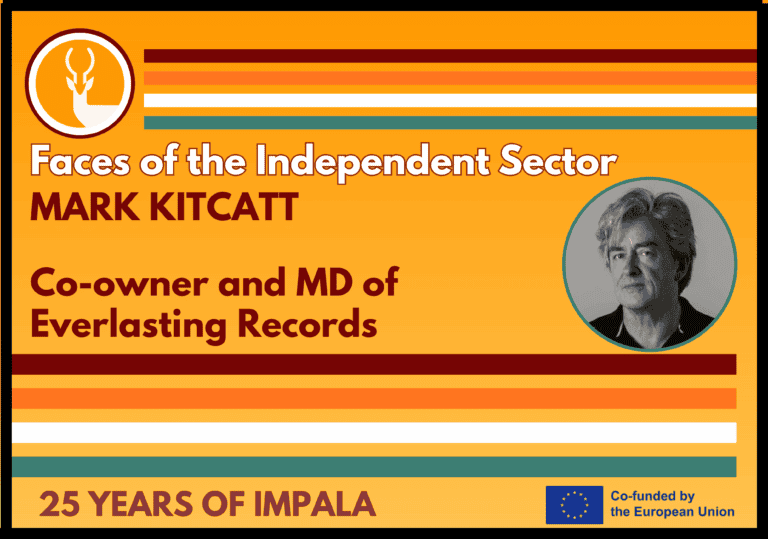
MARK KITCATT (EVERLASTING RECORDS) HIGHLIGHTS THE IMPORTANCE OF INDEPENDENCE AND COLLABORATION IN SHAPING THE DIGITAL MUSIC MARKET IN THE LATEST EDITION OF IMPALA’S ‘FACES OF THE INDEPENDENT SECTOR’
Brussels, 1 September 2026
As part of IMPALA’s Faces of the Independent Sector storytelling series, co-funded by the European Union, and celebrating our 25th anniversary, we are sharing the eighth interview in the series with Mark Kitcatt, co-owner, director and manager of Everlasting Records and Popstock Distribuciones, chair of WIN (Worldwide Independent Network) and co-chair of IMPALA’s streaming working group.
In the interview, Mark describes how he got started in the music industry, from being a young ‘music nut’, working in the warehouse of his favourite indie label in London to working with some of the world’s biggest acts while running his own record label and distribution company in Spain.
Mark talks about the importance of independence and having the freedom to be able to make your own calls and decisions, as well as working with like-minded collaborators. He also stresses how collaboration across the whole sector is essential, especially when it comes to the digital market. He highlights IMPALA’s new recommendations, set out in our recently issued Digital Music Plan.
What do you do in the music sector?
“I co-own and direct, and manage the Spanish music companies, Everlasting Records and Popstock Distribuciones. We were established in 1991, and we’re involved in recording, publishing, marketing, promoting and physical and digital distribution. We work with artists and labels from all over the world, looking after their interests in Portugal and Spain, and sign and record Spanish language artists and try to market them and represent their interest worldwide.
I also chair WIN, and co-chair Impala’s streaming group. IMPALA has produced three influential streaming plans since 2021, with the help of the independent community, and our latest recommendations cover the whole digital market.
How did you start working in the music sector?
“I went to work in the Rough Trade warehouse when I was 21, mid-80s, after leaving University. I was a music nut, really, all the friends I’ve made from my teens onwards have been the same, and to this day, we all wang on at each other every day on the various media now available to devoted wangers about music and artists old and new. I’m very lucky to spend my life in that world – when I was 14 or 15, labels like Stiff, Small Wonder, Beggars Banquet and Factory…. but above all, at that particular moment, formative for me, Rough Trade, and the shops they dealt with, were my sustenance, they were a connection to my world, what we now think of as our wider community. So of course, I ended up working there. I moved from London to Spain in 1990 and set up the companies serving said community over the next few years.”
What does being independent mean to you?
“Being independent is about making your own calls and decisions successively, probably various times, daily, and doing it with artists, creators, collaborators and colleagues who are all in the same boat, with the same inclination. In our context I think it is mostly about trying to use everything that adds up to a music industry – shops, fans, platforms, critics, divulgers, media, venues and the rest – to make space and time around creators for them to express themselves. Artists need space and they need support, it’s not just labels who can provide that, there are managers and other figures of great integrity and imagination doing a similar job, but they can deliver most when they team up with a simpático label partner.”
What are the biggest opportunities for the independent sector today?
“The independent sector attracts bright and fidgety people, agitators, it always will, I think and that’s our strength. I’m on the WIN board and every year we add new creative cohorts to our throng, from new countries and continents, a new set of independent labels with names and rosters redolent of the places and the people that move and shake those places and scenes. Our opportunity is that community, it’s a spirit that all the fencers-in and definers and dominators never will be able to snuff out. Our opportunity is just to keep listening.”
What are the biggest challenges for the independent sector today?
“Recorded music, especially the longer form with the opportunities it affords artists to stretch out and experiment, needs to recover economic value and occupy a more central place in the music world. That is the way to bring through new and challenging artists and fill venues, sound track our lives and interpret the world for us.
The obstacles are always to do with our options and outlets being reduced, we need strong independent partners and structures. Concentration is lethal, at distribution level, platform level and on the live circuit. We have to fight it however we can and work to offer alternatives.
The digital market is at the centre of both issues and it’s the way in and the first stopping point for fans now. As I said when we adopted IMPALA’s new recommendations early this summer: “Collaborating on these proposals from the independent sector will stimulate new investment in groundbreaking new music and support for the artists who create it.”
What change would you like to see in the music industry?
“I’d like to see the music industry collectively acknowledge that we’re serving something much bigger than our own selves, or companies, or profits, and work according to that idea. Music is our universal language (small “u”) – nobody owns it.”
What tips would you give to others starting out in the independent sector?
“Your whole career is going to be about trying to listen better, start now.”
Describe the independent sector in one word.
“Hopeful.”
What are the key projects or priorities you will be working on over the next 12 months that you would like to highlight?
“Le Parody, Cryymm, Guadalupe Plata, Vacaciones Permanentes and Xenia Rubinos are all delivering new albums in the next six months, while Waikiflow, Sofía Comas and Isleña Antumalen are toruing their recent releases all around the world. On the distribution side there are a range of inspiring projects, from Fontaines, Phoebe Bridgers and Erykah Badu to Twisted Teens, Julia Jacklin and scores more.”
What’s on your playlist?
- Charles Mingus – Wednesday Night Prayer Meeting (Live Version)
- Le Parody, Puttanesca (De Momento) – Por saber de dónde vengo
- Isleña Antumalen – KO
- Mercury Rev – Something for Joey
- The Fall – C ‘n’ C-S Mithering
- The Raincoats – In Love
- Waikiflow – De cordillera a mar
- Xenia Rubinos – Lonely Lover
- Angel Bat Dawid – We Are Starzz
Antonio Fernandez, Pedro de Dios – Fandango Del Coche Fúnebre
Listen to Mark’s full playlist on Spotify.
Check out previous editions of the series with Merlin’s Shrina Patel, ANMIP’s Kristiyana Georgieva, Glitch Records’ Pavle Eftimovski, STOMP’s Luciano Winter, FÉLIN’s Céline Lepage, !K7’s Andrea Lacroix and Warp Records’ Caroline Hansen.
About Faces of the Independent Sector
As part of IMPALA’s 25th anniversary and #WhyIndependentsMatter programme, the Faces of the Independent Sector interviews spotlight the creativity and the diversity of European independent music companies. The series shares the stories from the perspectives of owners, employees, and other key players. By highlighting their successes, struggles, and day-to-day realities, the campaign reveals the sector’s leaders and the stories that make it thrive. This project is co-funded by the European Union.
About IMPALA
IMPALA was established in 2000 and now represents over 6000 independent music companies in Europe. 99% of Europe’s music companies are small, micro and medium businesses and self-releasing artists. Known as the independents, they are world leaders in terms of innovation and discovering new music and artists – they produce more than 80% of all new releases and account for 80% of the sector’s jobs. IMPALA’s mission is to grow the independent music sector sustainably, return more value to artists, promote diversity and entrepreneurship, improve political access, inspire change, and increase access to finance. IMPALA works on a range of key issues for its members and started a new co-funded work programme as an EU cultural network in 2025. IMPALA runs various award schemes and has a programme aimed at businesses who want to develop a strategic relationship with the European independent sector – Friends of IMPALA. This year we are celebrating our 25th anniversary with a series of interviews Faces of the Independent Sector and other features, see more here.
