
Introduction
Streaming manipulation refers to activities that distort music consumption, measurement or monetisation on digital streaming platforms. It includes practices that do not reflect genuine listener engagement or demand, and which are intended to influence streaming statistics, visibility and the allocation of revenues across rightsholders, ultimately diverting revenues away from legitimate artists and labels. AI has exacerbated these practices, both by enabling increasingly sophisticated automated bot activity and by making it easier to generate volumes of content that can be used to support and monetise such manipulation, as illustrated by the Michael Smith case in the US.
The case also demonstrates that such practices amount to theft, which costs the music industry an estimated $2bn a year and causes long-term damage for labels and artists.
Streaming manipulation can broadly be divided into demand-side manipulation and supply-side manipulation. Demand-side manipulation involves artificially generating or directing listening activity that does not reflect genuine listener intent. Supply-side manipulation involves the creation, use, or exploitation of content in ways designed to distort the streaming ecosystem, divert revenues, or otherwise influence platform outcomes. While these categories may overlap in practice, distinguishing between them helps clarify the different forms of harm involved and the measures needed to address them.
It is difficult to assess the full scale of streaming manipulation, as definitions vary across platforms and only detected activity can be measured. Industry estimates suggest that a meaningful share of global streams may be associated with that, with Beatdapp indicating figures of around 10% of total streams although differences in detection systems and the rapidly evolving nature of manipulation tactics make this uncertain.
Streaming manipulation was often concentrated around new releases[1], where artificial activity was used to inflate early momentum. It is now increasingly distributed across the full lifecycle of a track or album and increasingly represents flooding strategies at market level[2].
When it comes to tackling this issue, the whole music industry has an important role to play. In 2019, streaming services and music industry representatives signed a voluntary Code of best practice on streaming manipulation. We seek an urgent update to this code as it provides a strategic framework for addressing the issue across the sector and remains the only pan-industry initiative of its kind. It demonstrates that, despite the diversity and fragmentation of the music industry, stakeholders can come together to address shared challenges. Since then, other initiatives, such as the Music Fights Fraud Alliance have been launched and play an important operational role in supporting the detection and prevention of streaming manipulation. Cooperation across the market remains crucial to address this issue.
IMPALA also condemns other forms of streaming manipulation, including the creation of fake or misleading artist profiles, the impersonation of legitimate artists, and the unauthorised upload or re-upload of existing recordings under different names or in modified forms. Such practices distort the market, undermine trust and, where protected recordings are used without authorisation, constitute copyright infringement.
In this note, IMPALA attempts to draw attention to manipulation tactics and how to detect them, including abnormal data patterns and red flags, as well as possible actions to take in response. Tactics will continue to evolve, and no single indicator is enough to confirm manipulation. It is therefore important to continuously monitor streaming data and consider the broader set of signals when assessing potential manipulation.
[1] Due to the commercial and algorithmic sensitivity of early streaming activity in digital music services which can affect chart eligibility, editorial and algorithmic playlist consideration, and recommendation system visibility.
[2] In April 2026, Deezer announced that around 75,000 fully AI-generated tracks are uploaded to the platform every day, accounting for approximately 44% of total daily uploads. Although they currently represent only a small share of total streams, this illustrates how quickly AI-generated content is scaling across streaming catalogues, increasing the volume of material circulating within the ecosystem.
The case also demonstrates that such practices amount to theft, which costs the music industry an estimated $2bn a year and causes long-term damage for labels and artists.
Streaming manipulation can broadly be divided into demand-side manipulation and supply-side manipulation. Demand-side manipulation involves artificially generating or directing listening activity that does not reflect genuine listener intent. Supply-side manipulation involves the creation, use, or exploitation of content in ways designed to distort the streaming ecosystem, divert revenues, or otherwise influence platform outcomes. While these categories may overlap in practice, distinguishing between them helps clarify the different forms of harm involved and the measures needed to address them.
It is difficult to assess the full scale of streaming manipulation, as definitions vary across platforms and only detected activity can be measured. Industry estimates suggest that a meaningful share of global streams may be associated with that, with Beatdapp indicating figures of around 10% of total streams although differences in detection systems and the rapidly evolving nature of manipulation tactics make this uncertain.
Streaming manipulation was often concentrated around new releases , where artificial activity was used to inflate early momentum. It is now increasingly distributed across the full lifecycle of a track or album and increasingly represents flooding strategies at market level.
When it comes to tackling this issue, the whole music industry has an important role to play. In 2019, streaming services and music industry representatives signed a voluntary Code of best practice on streaming manipulation. We seek an urgent update to this code as it provides a strategic framework for addressing the issue across the sector and remains the only pan-industry initiative of its kind. It demonstrates that, despite the diversity and fragmentation of the music industry, stakeholders can come together to address shared challenges. Since then, other initiatives, such as the Music Fights Fraud Alliance have been launched and play an important operational role in supporting the detection and prevention of streaming manipulation. Cooperation across the market remains crucial to address this issue.
IMPALA also condemns other forms of streaming manipulation, including the creation of fake or misleading artist profiles, the impersonation of legitimate artists, and the unauthorised upload or re-upload of existing recordings under different names or in modified forms. Such practices distort the market, undermine trust and, where protected recordings are used without authorisation, constitute copyright infringement.
In this note, IMPALA attempts to draw attention to manipulation tactics and how to detect them, including abnormal data patterns and red flags, as well as possible actions to take in response. Tactics will continue to evolve, and no single indicator is enough to confirm manipulation. It is therefore important to continuously monitor streaming data and consider the broader set of signals when assessing potential manipulation.
I. Demand-Side Manipulation
Demand-side manipulation refers to practices which are largely referred to as artificial streaming. In this context, three broad categories of actors can often be identified:
- criminal or fraudulent operators who organise and profit from manipulation schemes;
- artists, labels or rights holders who purchase promotional services without necessarily understanding that those services rely on manipulation techniques; and
- artists and labels who become victims of manipulation when their catalogues, profiles or recordings are used without their knowledge as part of fraudulent activity.
Again, distinguishing between these groups is important when considering appropriate responses, enforcement measures and support mechanisms.
What is artificial streaming?
Artificial streaming refers to activities that inflate stream counts without reflecting genuine listening and constitutes the most common form of demand-side manipulation. Artificial streams can be generated through:
- Hacking of existing user accounts or creation of fake
- Bots, scripts and other automated processes designed to manipulate streaming activity
- Coordinated streaming farms or click farms using networks of accounts or devices to generate streams at scale.
- Third-party promotional services that offer guaranteed streams, playlist placements, or rapid audience growth, and which may rely on undisclosed or artificial methods
These methods are often used in combination as part of layered systems of manipulation, rather than as isolated actions. Manipulation activity may also begin before music reaches streaming services. Artificial engagement on social media platforms (eg TikTok), including the use of bots, fake accounts or coordinated engagement campaigns, can be used to direct traffic towards streaming services and create the appearance of audience demand.
Some artists and labels may engage with third-party promotional services believing they are receiving legitimate marketing support. However, certain services that promise guaranteed performance outcomes may rely on artificial streaming techniques. This can expose artists and labels—sometimes unknowingly—to risks such as financial penalties, content takedowns, reputational damage, and loss of trust in audience data.
These practices are increasingly enabled and scaled by automation technologies, including AI and generative tools.
Why is artificial streaming bad for an artist/label?
Artificial streaming can temporarily inflate the streaming statistics of a track or artist, creating the impression of stronger performance than is actually the case. However, streaming services actively detect and remove artificial streams. This can lead to later adjustments in reported figures and sudden drops in plays and audience numbers.
- It is important to recognise that artists and labels may be affected by artificial streaming without having initiated or authorised it. Fraudulent operators may target legitimate catalogues, artist profiles or recordings as part of broader manipulation schemes. Enforcement measures should therefore distinguish, wherever possible, between bad actors and victims of manipulation.
- It also distorts how revenue is distributed. Because artificial streams do not reflect genuine listener demand, they do not contribute to real audience growth. This can result in an unfair redistribution of income between rightsholders. This undermines trust in streaming data and damages confidence in the wider music ecosystem.
- Artificial streaming can also trigger enforcement measures from streaming services and distributors, from content removal to restrictions on releases, or financial penalties depending on platform policies[1]. It can also have broader commercial and reputational consequences. Tracks or artists associated with artificial streaming risk being excluded from charts or editorial opportunities and may see their eligibility for certain promotional tools affected. Algorithmic recommendation systems can also be distorted by artificial activity, reducing the accuracy of recommendations and weakening long-term visibility with real audiences. Accurate fan data is now crucial for delivering and assessing effective marketing campaigns and building successful artist businesses, and if stream manipulation is employed it becomes impossible to distinguish between actual fan data and artificial fan This substantially decreases the value and reliability of streaming analytics.
- An analysis conducted within IMPALA’s Digital Committee illustrates how an artificial streaming campaign can operate in practice. In the end, the streams generated through this campaign were identified and removed by Spotify as part of their anti-streaming manipulation policies. And given the new rules on the platform regarding streaming manipulation, this initiative would now trigger a fine to be paid by the distributor of the label who made the test.
- The analysis also highlights a number of red flags that can help identify whether a track is generating artificial streams, and these should be carefully monitored in light of the risks described above. This is the focus of our next section.
How to know if a track generates artificial streams?
Streaming manipulation can affect genuine artists, as fraudulent activity may include legitimate tracks within broader automated listening patterns such as bot-driven streams, streaming farm activity, or fake playlists. These systems often mix real and targeted content in ways designed to resemble normal listening behaviour. Streaming platforms can also reflect this distorted activity in how music is recommended or surfaced to listeners, which may affect related tracks. This is why it is important to be able to identify whether a genuine track is being impacted by artificial streams.
- Regularly review your streaming data and look for unusual patterns. Consistent monitoring is essential to help distinguish between organic growth and potentially artificial activity.
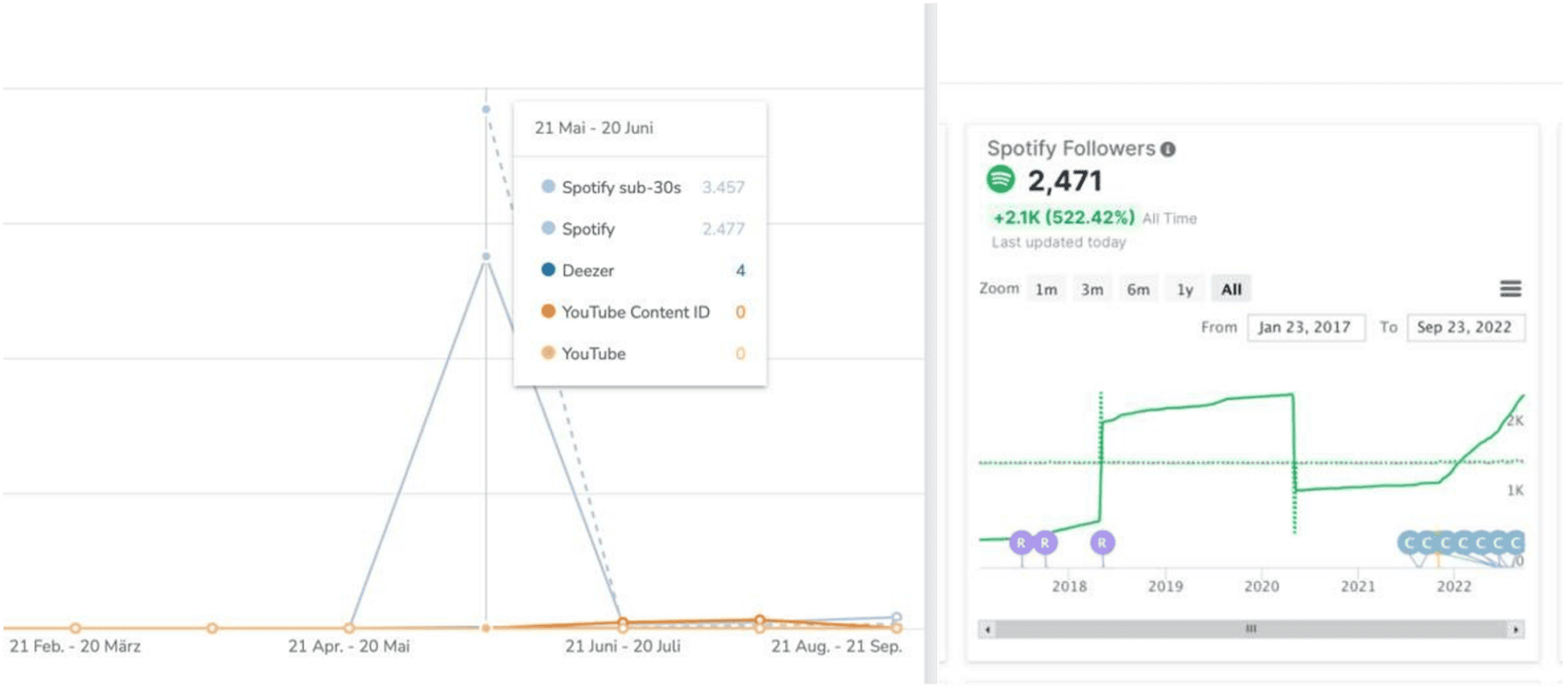
- Look for sudden spikes in streams or followers over a short period of time. Spikes can be driven by legitimate factors such as a track achieving sudden success on TikTok, but they can also signal that further investigation is needed.
- Usually, artificial streams generated through fake accounts or automated activity may appear as short-lived peaks in performance, followed by a rapid decline if those accounts are detected and removed by the platform.
- Pay attention to where streams are coming from. Unusual geographic patterns or audiences that do not match an artist’s typical listener base can sometimes indicate artificial activity.
- Look at the sources of streams, including playlists. A high volume of streams coming from unknown or low-quality playlists, or repeated appearances across unrelated tracks, may be worth reviewing.
- Consider the relationship between streams and overall audience behaviour. A track with high streaming numbers but limited audience growth or engagement may indicate that not all activity reflects genuine listener interest.
- If a track is flagged for suspected manipulation, maintain detailed records of promotional activity, marketing campaigns, playlist placements and audience engagement. This information may help demonstrate legitimate sources of growth and support appeals with distributors and platforms.
- Below are some examples of suspicious spikes in streams and followers:
How to identify a fake playlist?
- Tracks can also generate artificial streams when they are placed on a fake playlist as part of fraudsters’ attempts to disguise manipulation and/or profit from a track’s visibility. This would happen usually with third party When well curated, third party playlists can have an important role to play when it comes to artist discovery. However, while they can generate a significant amount of followers, even the most influential ones would usually generate quite a small amount of streams.
- Exercise caution when dealing with playlist promotion services that guarantee placements, streams or audience growth. Legitimate playlisting opportunities generally cannot guarantee performance outcomes.
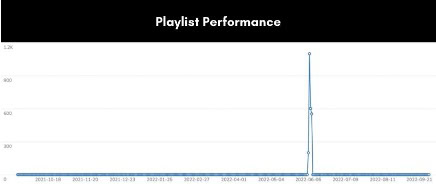
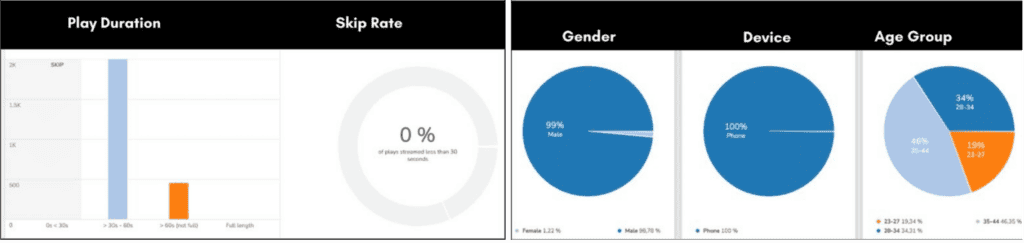
- Look at the performance of a playlist curated by a third When they generate an impressive amount of streams, this usually is a red flag. You can also analyse the data of your own songs on the suspicious playlist and compare it to their performance on other playlists. Here for example, the filters are particularly telling: the playlist’s performance was close to 0 for months before climbing up to 1.2k over a very short period and end up at 0 again (screenshot 1 below). When looking at a specific song on this playlist, we see that it was never played for less than 30s, but also very rarely played in its entirety, when “full length” would normally get the share of the chart (screenshot 2 below). Lastly, we see that the song was played almost only by male listeners, and specifically from a phone, when this type of data would normally be more diverse (screenshot 3 below).
- It is also useful to assess the overall quality and coherence of a playlist, including whether the track selection feels consistent in style or theme, and whether the playlist appears stable over time or changes in unusual ways. Lack of coherence or frequent unexplained changes may be additional indicators that a playlist warrants closer attention. Tools like Chartmetric’s are very useful for this as they provide a lot of relevant information on most playlists (and on most platforms): labels featured, music genres, if the playlist has changed/been refreshed, when and how, etc.
Other types of red flags -
Unusually high streams per listener, or a high concentration of streams linked to a small number of accounts or sources, sudden or unexplained increases in streams from territories where an artist has little or no known audience or promotional activity, a high number of streams of 30 seconds (minimum for a track to start generating revenue).
-
Unusually low skip rates or patterns of repeated full-length playback that appear highly uniform, repeated looping behaviour or highly repetitive listening patterns, a low number of streams of full tracks.A low number of unique users.A high number of streams coming from playlists with very few followers.
Limited sources of streams e.g., all streams come from a single playlist.
II. Supply-side manipulation -
In contrast to demand-side manipulation, supply-side manipulation refers to practices involving the creation, use, or exploitation of content in ways designed to facilitate manipulation or distort the streaming ecosystem.This can include:
-
Creation of content primarily intended to support fraudulent streaming activity
-
Theft, unauthorised use, re-uploading, or versioning of existing recordings
-
Repeated upload of identical or substantially similar recordings across multiple releases or artist profiles to generate artificial streams
-
Other content practices (including those that may be lawful and compliant with platform rules) but which aim to distort royalty allocation, revenue distribution, or broader platform dynamics.
These practices differ from artificial streaming itself but can contribute significantly to market distortion and diversion of revenues within the streaming ecosystem.
Indicators of potential supply-side manipulation
Unlike artificial streaming, many forms of supply-side manipulation are difficult for individual labels and artists to detect directly, as they often require visibility across large catalogues and multiple services. DSPs and distributors are therefore particularly well placed to identify these practices and should continue developing tools and procedures to address them. Here are some areas that they can monitor:
- repeated uploads of identical or substantially similar recordings across multiple releases, artist profiles or distributors;
- large-scale creation of artist profiles or catalogues showing highly repetitive content patterns;
- unauthorised reuploads or modified versions of existing recordings;
- networks of related artist profiles sharing common metadata, content characteristics or distribution patterns;
- unusually high volumes of content uploads over short periods of time;
- patterns suggesting the use of content primarily intended to support manipulation or exploit platform systems.
Indicators of potential supply-side manipulation
The rise of AI and generative AI has changed the economics of streaming manipulation. Low-effort content is not new: ambient recordings, white noise, rain sounds and other forms of functional audio have long existed on streaming services, and we have seen hour-long recordings of washing machine sounds and similar content attract millions of streams.
Without getting into the debate as to whether such streams are genuine or not, streaming services have increasingly taken steps to limit certain forms of abuse associated with this type of content. For example, Spotify has introduced minimum-length requirements for some functional audio content while Deezer has removed such content altogether and replaced it with its own non-monetised catalogue.
Generative AI creates a new challenge because it makes it possible to create music itself in seconds and at almost no cost. This removes one of the main barriers to streaming fraud: the need to create or acquire content before it can be uploaded and monetised.
AI therefore affects both sides of the manipulation ecosystem, by facilitating automation and scaling of artificial listening activity on the demand side, and enabling the rapid creation of large volumes of low-cost content on the supply side.
Streaming manipulation has long relied on combinations of content, accounts and automated listening systems working together. What AI changes is the ease with which these schemes can be established and operated. By lowering the cost of content creation and making automation more accessible, AI reduces barriers to entry and makes sophisticated manipulation techniques available to a wider range of actors. It also creates the potential for such activity to be deployed at a much greater scale (as shown by Deezer’s figures).
Large amounts of content are not necessary to generate significant revenues, however. The Michael Smith case in the United States demonstrated how automated content creation and automated streaming activity can be combined to divert substantial revenues away from legitimate artists and labels.
iii. What actions to take?
• Report suspected streaming manipulation to the relevant DSP using their official reporting channels. These vary by platform and may include dedicated email addresses, web forms, or artist dashboard support tools. For example:
- Spotify: abnormal-streaming-activity@spotify.com
- Apple Music: follow this link and explain your issue
- Deezer: create a claim here
• Where there is evidence of organised or criminal activity, consider reporting concerns through relevant national reporting mechanisms or national crime agencies / law-enforcement channels where appropriate.
• DSPs can make mistakes and wrongfully penalise a track for alleged streaming fraud (see here for example). It can take time and involve multiple exchanges between the label, the distributor and the streaming service. Labels can sometimes find themselves being directed back and forth between different parties, making the process frustrating and difficult to navigate. This is why it is helpful to have direct contacts and an established relationship of trust within the platform concerned, as this can significantly facilitate the resolution process.
- The Music Fights Fraud Alliance keeps updated a set of resources to help the industry stay on top of this issue:
iv. What actions to take?Other types of manipulation
About “manipulated” tracks
“Manipulated” tracks include sped-up, slowed-down or otherwise slightly “modified” versions of songs (e.g. sped-up/slowed down). Although some modified versions may be authorised, licensed, or platform-permitted, these “manipulated” tracks usually do not have legal licensing to be used, meaning they are infringing on copyright. The original artists therefore do not collect royalties on the song’s streams, which amounts to stealing.
In January 2024, a study by Pex counted over 1 million modified audio tracks on DSPs, diverting revenue away from rightsholders. TikTok’s most popular songs in 2023 were sped- up remixes.
Some platforms also plan to find ways to let their users modify tracks legally, as a feature as part of their subscription.
About fake artists and copyright infringement
The issue of fake artists is distinct from demand-side manipulation because streams generated by such content may still result from genuine listener activity. However, fake artist schemes may constitute a form of supply-side manipulation where content is created or deployed primarily to influence royalty allocation, playlist ecosystems or platform economics. Fake artists on streaming platforms are often pseudonymous acts with a limited catalogue of releases, sometimes achieving unusually high streaming volumes despite having little or no external online presence (such as a website, social media channels, or other public footprint).
They follow specific music guidelines to fit certain genres and themes (jazz, chill, peaceful piano) to appear on first-party playlists, which allows them to gather millions of streams each. The main issue as reported is that these producers receive a flat fee for their work, which is supposedly considerably lower than what any platforms would pay through a usual royalty deal, which has the effect of lowering the royalty pot.
Streams generated by these acts can be organic. However, we invite the community as a whole to speak out against these practices as they are meant to lower the overall royalty pot.
With the advent of generative AI, a further development has been the emergence of acts where music, artwork, imagery, and even artist biographies are fully generated using AI tools[1]. While the streams generated by these acts may still be organic, they contribute to broader concerns about diversion of revenues towards extremely low-cost content transparency, fairness and sustainability of the streaming ecosystem.
When it comes to the issue of streams generated through the upload of existing masters under new names, IMPALA sees it as clear infringement of copyright. Labels to which this happens can contact the platforms’ legal departments:
- Apple: https://www.apple.com/legal/internet-services/itunes/itunesstorenotices/
- Spotify: https://support.spotify.com/be-nl/report-content/
- Deezer: https://support.deezer.com/hc/en-gb/requests/new?ticket_form_id=360000057889
- Soundcloud: https://soundcloud.com/pages/copyright/report
- Tidal: support@tidal.com
- YouTube: https://www.youtube.com/copyright_complaint_form
- AmazonMusic:https://www.amazon.com/report/infringement/signin
Demands from the independent sector
IMPALA sees music services as its partners and believes that a more collaborative approach is needed to fix the problem of streaming manipulation. Continued cooperation between platforms, distributors, rightsholders, trade associations and anti-fraud initiatives remains essential to preserving trust in the streaming market.
We acknowledge the efforts made by streaming services to stop manipulation, but we encourage more exchanges with the community, in line with the pan-industry code signed in 2019.
For example, DSP reporting has now reached a level of accuracy that is widely recognised as good practice by the independent community, and we encourage all streaming services to continue developing and sharing this type of reporting with labels. This is crucial to maintain transparency across the streaming market.
However, we believe that these reports can be further improved, as the information provided in relation to manipulation remains limited. Greater transparency around the reasoning behind the removal of streams, as well as clearer categorisation of different types of manipulation, would help the industry respond more effectively. More granular information about other forms of manipulation (as detailed above) would also be valuable.
We also note that there could be more communication in between these reports. We know that services are working hard to fix this issue, and they shouldn’t hesitate to communicate more about it.
In addition, stronger preventive measures could be considered across the ecosystem. This could include enhanced “know your customer” (KYC) type provisions for accounts engaging in large-scale uploads or monetisation activity, as well as improved mechanisms to identify repeat offenders across platforms. Greater coordination between services could also help reduce the risk of “platform hopping”, where bad actors move between services.
The steps taken by platforms to limit certain forms of functional content are also positive developments. In relation to AI-generated content, Deezer’s transparency on the scale of AI uploads, as well as Spotify’s “artist badge” initiative for real artists only, are useful examples of what can be done.
On penalties for fraudulent tracks, IMPALA is of the view that they can be positive, provided that checks and balances are in place to prevent wrongful sanctions against genuine artists and tracks.
IMPALA believes that criminal streaming manipulation causes significant harm to artists, labels and the wider music ecosystem. Independent music companies should avoid any services that promise artificial growth, guaranteed streams or other forms of inauthentic engagement.
Previously, our guidance called for the launch of broader industrial dialogues on this issue, involving not only independents and streaming services, but also other key stakeholders such as distributors. Since then, initiatives such as the Music Fights Fraud Alliance have been launched to address streaming manipulation and fraud, which is a positive step forward. However, their scope remains limited in terms of participation and discussions are generally held in closed formats, leaving room for more open and inclusive industry-wide dialogue.
Lastly, IMPALA calls on the whole industry to speak out against moves to generate streams via the creation of fake artists and any other initiatives specifically meant to lower the royalty pot, as well as against reuploads of existing tracks under new names or any other types of copyright infringement, as all these practices have an unfair impact on the remuneration of labels and their artists while hurting significantly the industry’s image.
IMPALA’s recommendations on streaming reform are also relevant to addressing streaming manipulation. Further information can be found here.
References:
[1] Due to the commercial and algorithmic sensitivity of early streaming activity in digital music services
which can affect chart eligibility, editorial and algorithmic playlist consideration, and recommendation
system visibility.
[2] In April 2026, Deezer announced that around 75,000 fully AI-generated tracks are uploaded to the
platform every day, accounting for approximately 44% of total daily uploads. Although they currently
represent only a small share of total streams, this illustrates how quickly AI-generated content is
scaling across streaming catalogues, increasing the volume of material circulating within the
ecosystem.
[3] In April 2024 Spotify started charging a monthly €10 penalty to labels and distributors for each track
deemed to have significant levels of artificial streaming activity.
[4] See for example: https://www.theguardian.com/technology/2025/jul/14/an-ai-generated-band-got1m-plays-on-spotify-now-music-insiders-say-listeners-should-be-warned
