
MARIANA VORONINA (BEST MUSIC) TALKS ABOUT THE RESILIENCE OF THE UKRAINIAN MUSIC INDUSTRY, AND THE SPEED WITH WHICH INDEPENDENTS TURN IDEAS INTO ACTION
Brussels, 30 September 2026
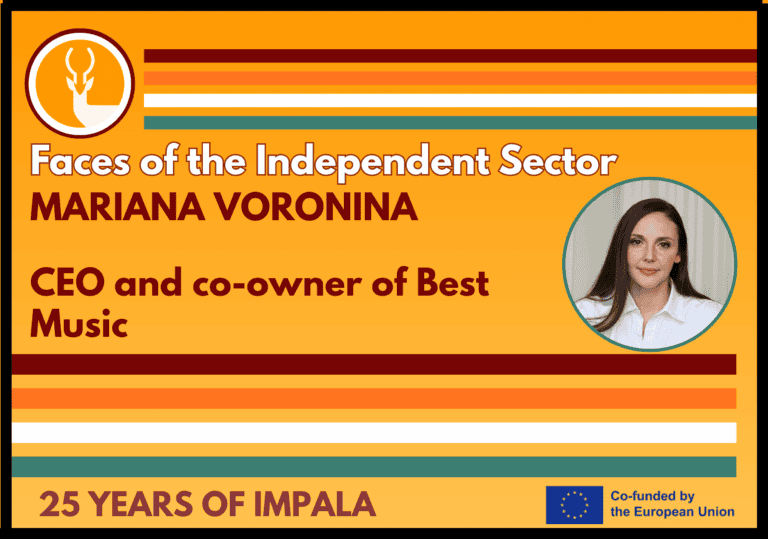
As part of IMPALA’s Faces of the Independent Sector storytelling series, co-funded by the European Union, and celebrating our 25th anniversary, we are sharing the ninth interview in the series with Mariana Voronina, CEO and co-owner of Best Music, a member of the Ukrainian Music Companies Association SPILNA.
In this latest edition, Mariana explains how the Ukrainian music industry has kept going while dealing with war on a daily basis.
She outlines the advantages of being independent, including the freedom to make decisions and the speed with which independents can turn ideas into action. She also discusses Best Music’s projects, “Value Music” and “Best Music Day”, as well as her wish to see global digital platforms expand their presence and marketing activity in Ukraine.
What do you do in the music sector?
“I’m the CEO and co-owner of Best Music, an independent Ukrainian label. We work with artists and rights holders at different stages, from distribution, publishing and rights management through to full PR and legal support for music projects.”
How did you start working in the music sector?
“After I graduated, I wanted to work as a lawyer in the entertainment business. I was lucky enough to find a job as an assistant to an intellectual property lawyer who specialised in working with artists and labels. So I came into the music industry through law, and I realised fairly quickly that advising the music business from the outside wasn’t enough for me. I wanted to be part of it and build it myself.”
What does being independent mean to you?
“This year my business partner and I are celebrating ten years of our independence. For us the word has a very literal meaning: ten years ago we stopped being employees of another company and started our own independent label.
For me, independence is first of all the freedom to make decisions. To decide for ourselves where the company goes, who we work with and how, which ideas we back, and which principles we’re not willing to change. But once I had my own business, I also understood that independence is a responsibility as much as a freedom. Responsibility for myself, for my team, for the business I’m building, and for every artist and rights holder who trusts Best Music with their music.”
What are the biggest opportunities for the independent sector today?
“I think one of the biggest advantages of the independent sector is speed. We’re far more mobile in our decisions and can get from an idea to making it happen very quickly. There’s no long chain of corporate approvals. Today we can come up with a new PR campaign for an artist, tomorrow launch an industry conference or join the work on proposed changes to Ukrainian legislation, and the day after that decide to create our own music show project and start building it. That ability to turn ideas into action quickly is, I think, one of the greatest strengths of the independent sector today.”
What are the biggest challenges for the independent sector today?
“For the Ukrainian independent sector, it’s impossible to talk about challenges outside the context of the war. It affects literally every part of our work.
We work through daily shelling and power cuts. We rebuild teams when our colleagues leave to defend Ukraine. We work with an unstable economy, a shortage of people, and a legal system that is going through a difficult transformation of its own. These aren’t separate problems. It’s one big snowball that Ukrainian business deals with every day.
The most important thing, though, is that the Ukrainian music industry has not put itself on pause. We keep releasing music, running concerts, creating new projects, developing the market and thinking about the future. For me that’s probably the most accurate definition of what resilience means in the independent sector.”
What change would you like to see in the music industry?
“If we’re talking about the global music industry, there’s still a lot for me to see and understand. But I know very clearly what the Ukrainian music sector needs today.
First of all, we need to grow stronger as an industry, not only as individual companies or artists. That means continuing to come together around professional associations, including SPILNA, which is a member of IMPALA. We need a strong shared voice that can represent the interests of the independent music sector both in Ukraine and internationally.
We need to take a more active part in shaping Ukrainian intellectual property legislation, and to learn from our European colleagues in building an effective collective rights management system.
Another large area is the work with global digital platforms. I’d like to see more of their presence and marketing activity in Ukraine, so that Ukrainian listeners increasingly choose legal streaming services over pirate resources. It also matters that Ukrainian users get the same platform features that are available in other markets, and that Ukrainian music gets more local editorial playlists and discovery tools.
For me, the next stage for the Ukrainian music industry is the move from a market of individual players to a strong, structured and competitive ecosystem.”
What tips would you give to others starting out in the independent sector?
“Work. Work a lot, gain experience and make mistakes, because mistakes are often what teach you the most.
The main thing is not to stand still. The music industry changes so fast that you have to keep changing with it: learning, watching how your competitors and other markets work, meeting people, asking questions, trying new things.
And probably one more important thing: never wait for the moment when you know everything before you start. Starting is how you learn.”
Describe the independent sector in one word.
“Boldly dynamic.”
What are the key projects or priorities you will be working on over the next 12 months that you would like to highlight?
“Honestly, there are a lot of ideas 🙂
For Best Music, one of the nearest projects is our educational event Best Music Day, which we’re holding for the fifth time this year, traditionally on 1 October, International Music Day.
We also want to come back to our social project “Value Music”. Its goal is to gradually change the way music is treated in Ukraine: to explain to listeners that music has value and is worth consuming legally, and to businesses that using music means fair remuneration for rights holders, including through the collective management system.
There are creative plans too. We’re working on the idea of a YouTube music project called Best Hit, where well-known Ukrainian artists swap their hits and create their own versions of songs that Ukrainians already know and love.
But my priorities go well beyond Best Music. I want to keep putting time and energy into developing SPILNA, strengthening the Ukrainian independent music sector and its links with the European industry.
And a separate big area for me as a lawyer is legislation: working on the changes that will help the Ukrainian music market grow, and improving the collective management system. It’s one of the most painful and at the same time most important topics for our industry.
And if I’m being completely honest, there’s one more task for the next 12 months that all of us in Ukraine share, the minimum one: to hold on. Everything else we’ll build in parallel.”
What’s on your playlist?
- Zlata Ognevich – One Day
- TVORCHI – Shine
- Jerry Heil, MONATIK, Evgeny Khmara – ВИМОЛИВ
- Ed Sheeran – Perfect
- MONATIK, DOROFEEVA – If you know what I mean
- Olivia Rodrigo – stupid song
- Kadnay – Запах твого волосся
- Phil it – Пірнаю
- ROXOLANA – Мистецтво
Taylor Swift – The Life of a Showgirl
Listen to Mariana’s full playlist on Spotify.
Check out previous editions of the series with Merlin’s Shrina Patel, ANMIP’s Kristiyana Georgieva, Glitch Records’ Pavle Eftimovski, STOMP’s Luciano Winter, FÉLIN’s Céline Lepage, !K7’s Andrea Lacroix, Warp Records’ Caroline Hansen and Everlasting Records’ Mark Kitcatt.
About Faces of the Independent Sector
As part of IMPALA’s 25th anniversary and #WhyIndependentsMatter programme, the Faces of the Independent Sector interviews spotlight the creativity and the diversity of European independent music companies. The series shares the stories from the perspectives of owners, employees, and other key players. By highlighting their successes, struggles, and day-to-day realities, the campaign reveals the sector’s leaders and the stories that make it thrive. This project is co-funded by the European Union.
About IMPALA
IMPALA was established in 2000 and now represents over 6000 independent music companies in Europe. 99% of Europe’s music companies are small, micro and medium businesses and self-releasing artists. Known as the independents, they are world leaders in terms of innovation and discovering new music and artists – they produce more than 80% of all new releases and account for 80% of the sector’s jobs. IMPALA’s mission is to grow the independent music sector sustainably, return more value to artists, promote diversity and entrepreneurship, improve political access, inspire change, and increase access to finance. IMPALA works on a range of key issues for its members and started a new co-funded work programme as an EU cultural network in 2025. IMPALA runs various award schemes and has a programme aimed at businesses who want to develop a strategic relationship with the European independent sector – Friends of IMPALA. This year we are celebrating our 25th anniversary with a series of interviews Faces of the Independent Sector and other features, see more here.
