
UKRAINIAN MUSIC TODAY: SIX VOICES FROM THE INDUSTRY
Brussels, 27 November 2026
As part of IMPALA’s Faces of the Independent Sector storytelling series, co-funded by the European Union, and celebrating our 25th anniversary, we are sharing a special Ukraine edition, prepared together with the Ukrainian Music Companies Association SPILNA.
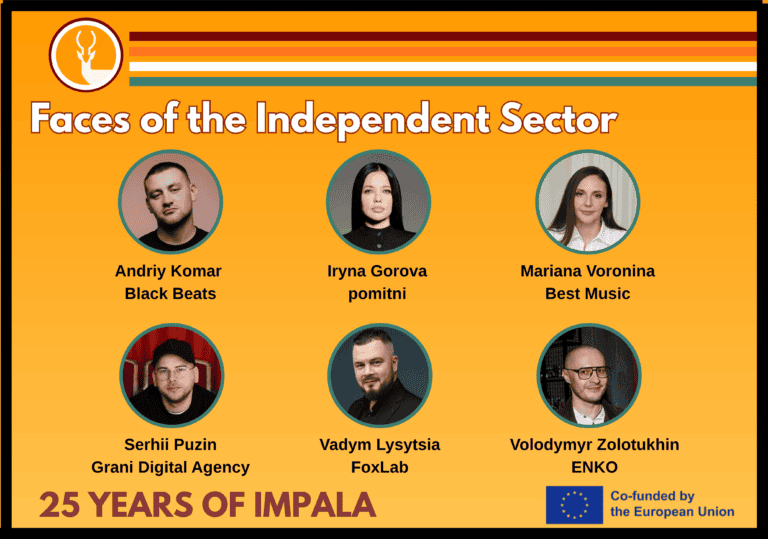
Following our September interview with Mariana Voronina of Best Music, we continue our introduction to the Ukrainian music industry. Mariana is joined by founders and executives from four more labels and a digital agency, who talk about their work, their artists and where Ukrainian music is heading. Each of them answers questions shaped around their own story.
Introduction from SPILNA
Anatolii Khrustovskyi, SPILNA: “Ukrainian music companies today are signing new artists, reaching international markets and investing in infrastructure: studios, education, research. All of this happens during the war, which affects the work every day, but each company’s story is much broader than that. In this feature you will meet a label with more than 150 artists on distribution, a label that grew out of a YouTube channel, a team that relaunched under a new name with fifteen years of experience behind it, a producer who has been making hits for more than twenty years, a digital agency with more than 800 million TikTok views to its name, and a label with a catalogue of more than 9,000 tracks. Together they show what Ukrainian music looks like today.”
Ukrainian music in numbers
67,837 | tracks released in 2025 |
8,151 | active artists in 2025 |
1,193 | debut acts in 2025 |
45 | artists with 100M+ total Spotify streams |
Data from the comprehensive study “Music Has Power” (pomitni, 2025). Releases and artists as of October 2025, Spotify streams as of July 2025: spilna.org.ua/docs/Music_Has_Power_2025.pdf
Volodymyr Zolotukhin, COO, ENKO
Founded in 2020, ENKO is a full ecosystem for artists in one team: more than 20 billion streams and more than 150 artists on distribution.
1. As of 2025, ENKO is Ukraine’s largest label by revenue and streaming volume. How do you manage to scale during the full-scale war, and what are the main obstacles you have to overcome?
“We didn’t scale in spite of the war, but through the decisions it forced us to make. In 2020 ENKO started as a label with one artist and a full production cycle, and in 2022 we opened distribution and became a multi-genre company. In 2024 we deliberately ended our production contracts with our biggest artists and handed over their trademarks, social media and performance rights to them. Instead, we focused on three areas: taking Ukrainian artists to audiences abroad, a full cycle of services in Ukraine, and our own media network. Today we have more than 150 artists on distribution, our catalogue has passed 20 billion streams on digital platforms, and revenue in the first quarter of 2026 grew by 28% year on year.
At the same time, we moved from managing individual stars to managing the catalogue as an asset. We introduced a system that tracks contracts, shares and earnings for every track, started buying catalogues and copyrights, and co-founded the music association SPILNA.
Most of the team works in Kyiv to the constant sound of sirens, explosions and power cuts. Because so many people have left the country, hiring is difficult. So for further growth it’s important to treat every track as an investment and to look for ways to represent Ukrainian music in foreign markets.”
2. ENKO’s mission is to unite Ukrainian artists to inspire people to change the world for the better. Which international markets are you focusing on first, and why?
“We focus first on two markets: the US and Poland. The United States is the biggest market by revenue per stream, and we moved there step by step. In 2024, 93% of our artist Carpetman’s listeners were already outside Ukraine. In 2025 we signed with Kobalt, one of the world’s biggest publishers, so that songwriting royalties and broadcast payments don’t get lost in a chain of intermediaries. This year Forbes Ukraine named ENKO as the label taking Ukrainian music to the American market.
Poland is just as important for us. It’s the closest market, with millions of Ukrainians, and at the same time a country with its own strong music industry and a Sony Music Publishing office, through which we administer part of our catalogue. We’re launching two projects there. The first is VINIL Vol. 1, a vinyl record with twelve songs by our artists, which we’re making together with Universal Music. The second is a Ukrainian artist recording songs in Polish for Polish listeners. It’s our first attempt to enter a local market directly rather than through the diaspora, by that market’s rules and in its language. If both projects succeed, we’ll have a working model for entering neighbouring markets through physical formats and local artists, and we’ll be able to scale it to other countries.”
Andriy Komar, Founder and CEO, Black Beats
Founded in 2019, Black Beats is a multi-genre label and publisher: distribution, publishing, PR, release promotion and booking.
1. Black Beats started as a YouTube channel and is now a label with its own studio in Kyiv. How did the channel become a label, and how has your audience changed over the years?
“Yes, it all started with a YouTube channel, a platform for promoting new music. The next logical step for us was to open our own distribution department, and together the two worked very well for developing artists. From 2022 we shifted our focus exclusively to Ukrainian artists and adapted our experience to the local market. We built a studio where mostly our signed artists work free of charge.
Today Black Beats is a partner for the music business. We work both with artists and with other labels and rights holders, bringing together a team, expertise and infrastructure for developing projects. Our mission is to create conditions in which artists and music companies can realise the potential of their projects and catalogues systematically, without chaos and without losing time, income or opportunities.”
2. You also administer copyrights. What does music publishing look like in Ukraine today?
“In our experience, publishing in Ukraine has great potential, but many authors and rights holders are not yet using every opportunity to monetise their catalogues. Among the problems are a lack of awareness of these opportunities and businesses using music without proper licences, which means authors are underpaid. Legal complexity remains a separate challenge, in particular how copyright is regulated and how remuneration is collected under martial law.
At Black Beats Publishing we collect authors’ royalties from digital platforms in Ukraine and abroad, help recover unallocated royalties, resolve disputes and work with music companies on public performance and broadcasting. Our goal is to make these processes clear for everyone involved and to help authors, artists and other rights holders realise the potential of their catalogues more fully.”
Iryna Gorova, Founder and CEO, pomitni
pomitni is a 360° label: distribution, publishing, PR, social media, booking, sales, legal support and repertoire. More than 1 billion streams.
1. Your story in the music industry began long before pomitni. When you relaunched as pomitni in 2023, you already had fifteen years of experience behind you. What did that time teach you, and what did you deliberately bring with you into the new label?
“The music industry has changed a lot over these years. We have gone from production centres that mostly invested in their own artists and built the business around them to a model where the label becomes a service company that gives artists the tools to grow. The full-scale war accelerated these changes even further and made us rethink how the business should work.
In 2023 we deliberately changed the model and relaunched the company as pomitni. I realised that working with a limited number of artists and investing in individual projects was not enough for sustainable growth. There is far more potential in building a system that lets different artists get professional services and grow according to their needs. So we moved to a service model: distribution and publishing, marketing, PR, social media, booking and work with brands.
What I brought with me is the experience of building artists’ careers and an understanding of how the industry works from the inside. But the logic of the work has changed. It matters to me that artists understand how their business is structured, what they spend money on, how their work is monetised and which tools will help them grow. That is why transparent processes, clear terms and access to reporting are not extra perks but the necessary basis of a partnership.
That is how I see pomitni’s role today: not just helping to release music, but creating conditions in which artists can develop their business and the Ukrainian music industry can grow into a full market and reach the international level.”
2. Beyond the label, pomitni invests in research and education for the whole industry. Why does that matter to you?
“In 2023, when pomitni was created, we faced a simple question: how many of us are there? How many artists are there in Ukraine, who listens to them, where do people listen to Ukrainian music and how does it affect society? It turned out there was not enough basic data to rely on when making business decisions. So we started researching listeners. That was the first step, and later, together with partners, we carried out the larger study “Music Has Power”. It is important to me that we can talk about the potential of Ukrainian music not only through individual success stories, but through concrete figures and facts.
But research alone is not enough. The industry needs cooperation. That is why I became one of the initiators of SPILNA, the Ukrainian Music Companies Association: to bring market players together and work on the market’s development jointly. We are now launching a course with SKVOT on how to release music, build an artist’s strategy and earn from music. It is an important step in bringing skilled people into the industry.
I believe Ukrainian music can grow much faster if we build shared infrastructure for it: research, education, financial tools and partnerships. Even the biggest label cannot change the whole market on its own. When we join forces, we can do more than develop individual artists: we can scale Ukrainian music in Ukraine and beyond.”
Vadym Lysytsia, Founder, FoxLab
Founded in 2022, FoxLab is a label and production centre: distribution, publishing, PR and booking, with its own studio, FOXXSTUDIOS, and full production.
1. You have been producing hits for more than twenty years, including “Sweet People”, which represented Ukraine at Eurovision 2010, and in 2018–2019 you were the music producer of X Factor Ukraine. How did you come to start your own label?
“For a long time we released our songs in cooperation with several music publishers, and every time we ran into questions about how the royalties we received were allocated and reported. Besides, when the idea of our own label came up, I had started creating new music projects. The main goal is to be as effective as possible in promoting music across different platforms, and to be fully transparent in receiving and distributing royalties among our artists, authors and rights holders.”
2. You have your own recording studio, FOXXSTUDIOS. What does it give the label and your artists?
“I have been producing music for Ukrainian pop artists for more than 20 years, so it was natural that the FOXXSTUDIOS production community became the foundation for the label. Today we all create music together for our artists. We give them access to our resources, experience and creative work, and that gives everyone a basic boost! Because the main thing in any singer’s career is the song, the hit. Everything else comes later.”
Serhii Puzin, Founder and CEO, Grani Digital Agency
Grani Digital Agency offers a full range of services: social media support for artists, promotion of music releases and digital distribution.
1. Grani is primarily an agency, although you also handle distribution. Why did you decide to join SPILNA, the Ukrainian Music Companies Association, and what does it give you?
“For us, SPILNA is above all a chance to be part of an association of the leading players in the Ukrainian music market and to work on developing the industry together.
Today it matters to join forces, share experience and stand up for the interests of the Ukrainian music business together. So we want our agency to take an active part: to share our expertise and contribute to how the industry develops.”
2. Your team has been promoting music for more than eight years. How have the things that make a track popular in Ukraine changed over that time?
“Over eight years the tools for promoting music have changed dramatically, and the change is only speeding up. What worked three months ago may no longer bring results today.
Digital promotion used to rely on targeted ads on YouTube, Google Ads and Meta. Today people increasingly discover new music through short videos on TikTok, Reels and YouTube Shorts. And simple organic content can sometimes do far better than an expensive production.
So it is no longer enough to advertise a track. You need to create content around it that people want to watch, share and use in their own videos.”
Mariana Voronina, CEO and co-owner, Best Music
A label since 2016, Best Music provides distribution, publishing, PR and legal services. More than 9,000 tracks and over 4 billion streams since 2021.
1. Public performance is one of the areas you manage rights in. Large Ukrainian retail chains, such as the Epicentr home and DIY hypermarkets, the Silpo supermarkets and the Aurora discount stores, keep paying for the music they use, even when they lose stores and warehouses to shelling. What does that say about the Ukrainian market today?
“I think above all it shows the extraordinary resilience of Ukrainian business and a gradually maturing attitude to intellectual property.
Today Ukrainian companies work in conditions most European businesses would find hard to imagine. They lose stores, warehouses and infrastructure, and have to keep adapting to new challenges. And despite all that, they keep meeting their obligations, including to the music industry.
For many years we have been working to make music in Ukraine seen not just as background for commercial spaces, but as intellectual property in its own right, whose use has value and a price.
Of course, I cannot say the Ukrainian market is already ideal. We still have a lot of work to do on a culture of music licensing, on transparency in how remuneration is collected and distributed, and on respect for intellectual property rights. And perhaps most importantly, even during the full-scale war, Ukrainian business is not giving up the principles a civilised market should be built on. For me that is a sign that the Ukrainian music industry has not only resilience but a future.”
Who Europe should hear next
We asked everyone the same question: which Ukrainian artist should Europe hear next, and why?
Volodymyr Zolotukhin, ENKO: “KHAYAT. He joined ENKO in January 2026, and in February he reached the final of Ukraine’s national selection for Eurovision. His song “Hertsy” is built on a combination that has already worked for Kalush Orchestra: an electronic base and ethnic vocals that need no translation. I believe he can win over European audiences above all through the quality, sound and originality of Ukrainian music, not only through the context in which it is made.”
Andriy Komar, Black Beats: “NANA SOLIS, an artist on our label, in whom I see potential for a European audience. She makes modern dance pop that combines electronic sound, lightness and nostalgia. In my view, her music can find listeners beyond Ukraine, because the rhythm, melody and emotion let you feel a song even without understanding the language.
I would also single out NASTEISHA. She works in alternative hip-hop, and her strength, as I see it, is her melodic delivery and expressive emotion. She already has a successful international collaboration, “İNTİHAR” with the Turkish rapper Era7capone, which for me shows how naturally Ukrainian-language delivery can sound in an international project.”
Iryna Gorova, pomitni: “I would like to single out Kazhanna. She represents a new wave of Ukrainian pop: original, bold and not afraid to step outside familiar formats. This year Kazhanna was invited to play Reeperbahn Festival in Hamburg, one of the key platforms for discovering new artists and building contacts with the international music industry.”
Vadym Lysytsia, FoxLab: “I think it would be great if it were MONATIK! He is a very talented and productive artist with a big audience among Ukrainians. For me, his experience in music and concert production, and in marketing, is what made the choice.”
Serhii Puzin, Grani Digital Agency: “Zlata Ognevich. Our team is directly involved in her international development. Zlata is now working on English-language music in three countries at once: Ukraine, the US and the UK. Her single “Fighter” was recorded at Elemental Recording in the US, where Prince and Dr. Dre once worked, and British producer Kojo Samuel, a BAFTA winner, worked on the song. Next comes a full English-language album of 7–8 songs in different genres, and preparation for European showcases.”
Mariana Voronina, Best Music: “I would like European audiences to discover Zlata Ognevich anew. Zlata is an artist with a unique voice, exceptional vocal skill and strong creative potential.
Zlata is now actively working on English-language material, and I would really like this new stage of her work to become a chance to present her talent to a much wider audience.”
Ukrainian music today is…
Volodymyr Zolotukhin, ENKO: “…an export product that has proved for four years in a row that there is demand for it on the global market.”
Andriy Komar, Black Beats: “…the challenge of turning powerful creative growth into a strong, resilient industry.”
Iryna Gorova, pomitni: “…not only part of our cultural identity but also a tool of influence that shapes how the world sees Ukraine.”
Vadym Lysytsia, FoxLab: “…the Ukrainian soul, heard through the explosions of war.”
Serhii Puzin, Grani Digital Agency: “…an industry that keeps growing despite the war, limited resources and the huge risks artists take on, and makes itself heard in the world through talent, its own investment and the dedication of Ukrainian musicians.”
Mariana Voronina, Best Music: “…a true hero that goes through countless trials every day and overcomes incredible challenges, but despite everything keeps sounding, growing, inspiring and supporting Ukrainians.”
Playlist: Ukrainian Music Today
We asked each company to pick two of its tracks it is proudest of.
- ENKO: Carpetman – You Will Never Know It & KHAYAT – Герци
- Black Beats: YAKAYA – ПРИПИНДА & Vasyl Bilous – Коло тебе
- pomitni: DOROFEEVA – FEEL THE HEAT & Hyphen Dash – Man of Love
- FoxLab: Maksym Borodin – Зозуленька & Nastia Balog – Калатало
- Grani Digital Agency: Zlata Ognevich – Fighter & MONATIK – Тому що…
- Best Music:“This is one of the hardest questions for us, because every Best Music release has its own creative story, talent and a lot of work by the team behind it. We would rather not single out just two tracks: we are proud of many of our artists and what they have achieved.”
Listen to the full playlist on Spotify.
Check out previous editions of the series with Merlin’s Shrina Patel, ANMIP’s Kristiyana Georgieva, Glitch Records’ Pavle Eftimovski, STOMP’s Luciano Winter, FÉLIN’s Céline Lepage, !K7’s Andrea Lacroix, Warp Records’ Caroline Hansen, Everlasting Records’ Mark Kitcatt, Best Music’s Mariana Voronina and AIM Ireland’s Colm Hanley.
About Faces of the Independent Sector
As part of IMPALA’s 25th anniversary and #WhyIndependentsMatter programme, the Faces of the Independent Sector interviews spotlight the creativity and the diversity of European independent music companies. The series shares the stories from the perspectives of owners, employees, and other key players. By highlighting their successes, struggles, and day-to-day realities, the campaign reveals the sector’s leaders and the stories that make it thrive. This project is co-funded by the European Union.
About SPILNA
SPILNA, the Ukrainian Music Companies Association, brings together music companies working in the Ukrainian market. Its mission is to develop Ukraine’s music industry, protect its interests, and integrate it into the global music market. It is a member of IMPALA and WIN.
About IMPALA
IMPALA was established in 2000 and now represents over 6000 independent music companies in Europe. 99% of Europe’s music companies are small, micro and medium businesses and self-releasing artists. Known as the independents, they are world leaders in terms of innovation and discovering new music and artists – they produce more than 80% of all new releases and account for 80% of the sector’s jobs. IMPALA’s mission is to grow the independent music sector sustainably, return more value to artists, promote diversity and entrepreneurship, improve political access, inspire change, and increase access to finance. IMPALA works on a range of key issues for its members and started a new co-funded work programme as an EU cultural network in 2025. IMPALA runs various award schemes and has a programme aimed at businesses who want to develop a strategic relationship with the European independent sector – Friends of IMPALA. This year we are celebrating our 25th anniversary programme #WhyIndependentsMatter with a series of interviews Faces of the Independent Sector, as well as reports and other features, see more here.
